Wednesday, June 15, 2011

Sausage Take 2


I was excited for the second helping of the sausage challenge after the first one was literally a ‘bust’ (broken sausage stuffer.) Yes, my sausage stuffer was down and out, but, as luck would have it this challenge was the one where we had to actually stuff sausage. Duh? I mean I knew that. I was privy to it the whole time . . . well not so much, but whatever…

Tonight’s menu:

 Waldorf Sausage: Rouge Creamery ‘Cave Man Bleu Cheese’ and Chicken Sausage on a French Baguette with Mayo spread Topped with Celery, Grapes, Apple, and Toasted Walnuts. 

Summer Corn and Italian Sausage Soup with Basil and Avocado   

            Now the proud owner of a ‘hank’ (144ft.) of casings I needed to think of some innovative fillings. After all I don’t think casings have a high re-sale value – at least I couldn’t find a Craigslist heading that seemed appropriate. I may even end up stuffing Halloween candy into them for next year.


            Poultry sausage is not exactly on the top of my list. On the other hand, the idea of exchanging the pork fat for some other fat was intriguing enough. I mulled over all the plausible animal fat substitutes but none seemed suitable. Racking my head for ‘alternative’ fat replacements: oil, eggs, YES – CHEESE! I would try to make a Waldorf Salad - no - Waldorf SAUSAGE.

Recipe for Success:

2 Chicken Thighs (approx. 2.5 lbs.) boneless, skinless, well marbled
2 Garlic Cloves, minced
1T Fresh Dill, Chopped
2 t Fresh Tarragon, Chopped
½ T Parsley, Chopped
2T Fleur de Sel
2 cracks White Pepper Mill
2 cracks Black Pepper Mill
Zest of 1 Lemon
1T Champagne Vinegar
t.t. Rouge River Cave Man Blue Cheese (I added about 3 oz)

1 French Baguette

1 Celery Stalk, Brunoise
1 Granny Smith Apple, Batonette
10 ea Red Grapes, Quartered
t.t Mayonnaise

.05lbs Raw Walnuts
Walnut oil (optional)

Make your sausage - cube your chick thighs into medium dice and pop them into the freezer. When the chicken is semi-frozen combine all remaining ingredients (except the cheese) in the bowl with the semi-frozen chicken. Work the mixture to distribute all the spice evenly. Grind through once on a Kitchen Aid and cook a tester to check for seasoning. When you're ready to stuff your sausage add the bleu cheese (Note: all of my sausage ingredients are cold.) Work and spread the cheese out evenly to resemble sausage marbling. Now your filling is ready to stuff into the casing. This recipe yields roughly 6 - 3” sausage links.

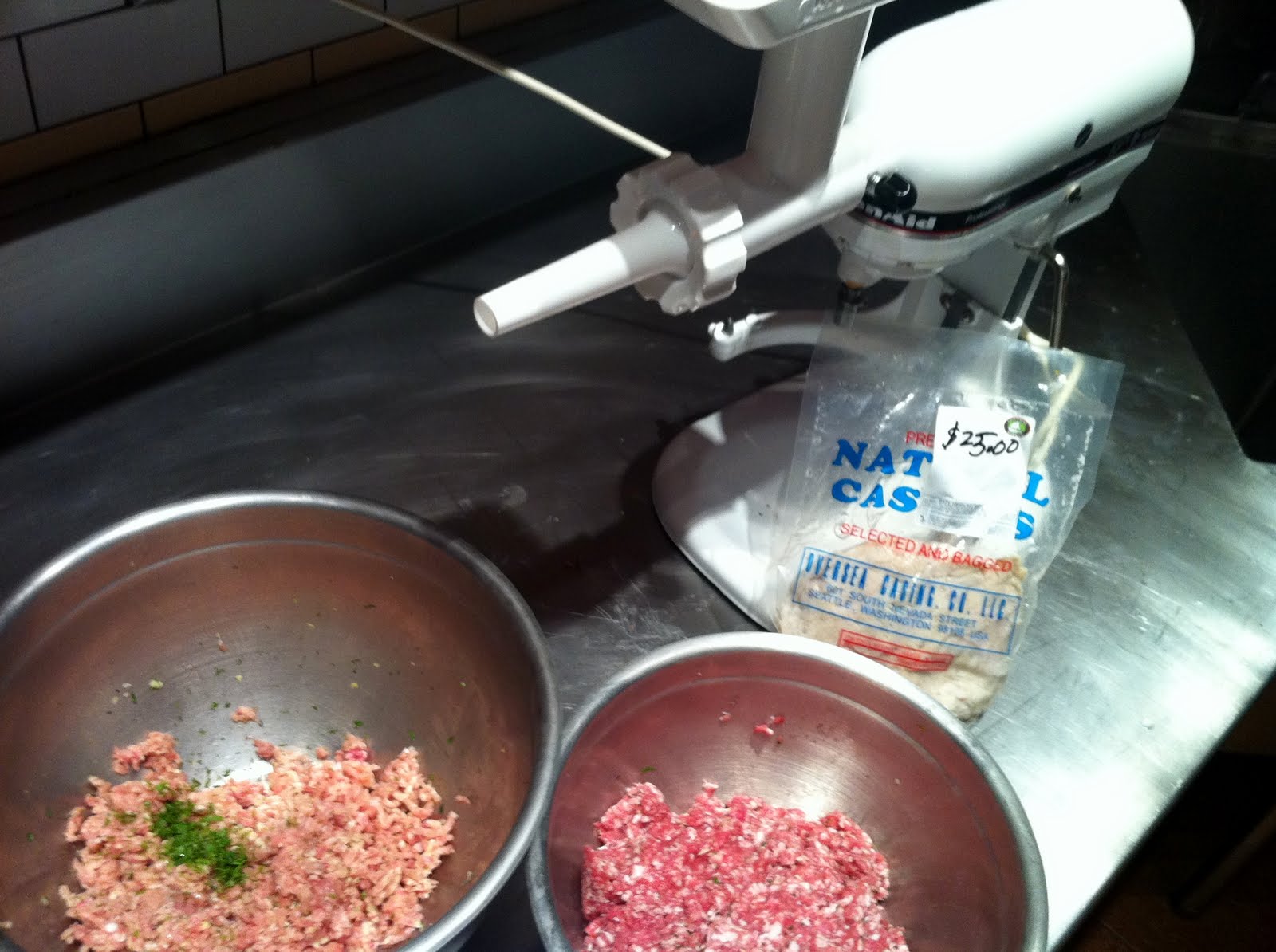

Next, sauté one link over medium flame until golden brown and delicious. Once the internal temperature is 165F remove from the heat and rest the meat in the pan. While the pan is resting toast your raw walnuts in a 400F oven for about 10 minutes until aromatic. While the walnuts are roasting prepare your fruits/vegetables and make your mayonnaise: 1 egg yolk to 1 c of canola oil, 1 t of Dijon mustard and salt and pepper to taste. If you don’t know how to make a mayonnaise, start by whisking your yolk with the Dijon slowly (drop by drop); whisking in your oil and only adding more once you have fully incorporated the previous oil drop completely.


            Once your walnuts are ready, toss them with a bit of walnut oil while still hot and season lightly with both salt and sugar. Slice and toast a piece of baguette and start plating: first a ‘schmear’ of mayo topped with celery.  Next, the quartered grapes, sausage, then top with the apple and walnuts. YUMMY! This sausage left such a great taste in my mouth you best believe there will be more like it to follow.


Next: the soup and sausage portion of the meal.


3 ears of yellow corn
2 T butter
t.t. salt
t.t. Black pepper

1 MICHAEL RUHLMAN Special Italian Sausage  

Garnish:
Avocado cut in half-moon shape
Tomato, brunoise
Genovese Basil Tips
Reserve Corn Kernels (roasted)

First make your sausage using the recipe in Michael Ruhlman book, "Charcuterie"

Visual Aid Fast Forward


Okay, so I usually encounter one or two problems and this time it was my casings. I must have been off because it took me three tries to not tear them.


This soup embodies summer for me. There is no smoke and mirrors here so only prepare this soup when you can obtain the best summer corn. Still a bit early in the season, I walked past a ‘luck would have it’ awesome display of corn and after what I call “self serve sampling”, found it was delicious. First reserve about 2 T of the whole raw corn kernels. The second key to this soup is the way of “milking” the corn and involves a single use kitchen tool called a ‘corn creamer’. Usually I’m not a fan of the single use items but I thought I should use it because it was already in my possession. What is does: scrape the seed and part of the husk to yield both the liquid and solids of the corn. Now this starchy job can get a bit messy and so I prefer to use it in the sink. 

When you are finished, place the raw scraped corn ears into a pot and fill with just enough water to cover them. Simmer over medium heat for 25 minutes – corn stock is a way to thin your soup without losing flavor. This recipe yields about 1 pint of soup so try to work as clean as possible in catching all of the solids and liquids.


Next, transfer your hard work into a Vita Prep blender and puree on high until smooth. Strain the soup using your finest slotted strainer. Pop the reserved raw corn kernels on a tray and place in a 375F oven and roast until brown - about 10 minutes. While the kernels are roasting, transfer your soup into a small pot and place over medium heat while stirring frequently. Note: if left unstirred too long, the starches will be quick to stick to the bottom of the pot and burn.
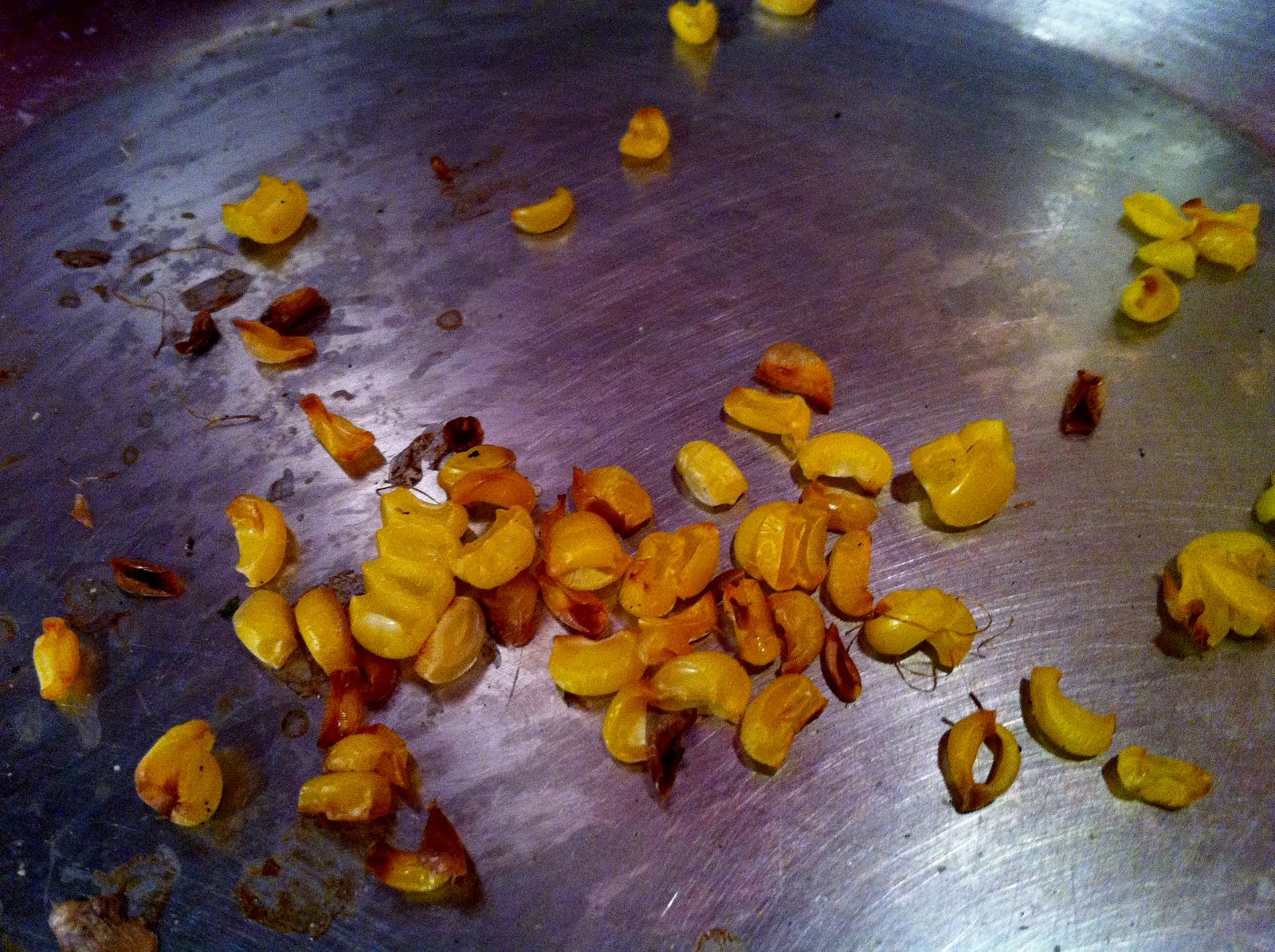
Sauté your sausages until golden brown all over. While your sausage is resting add butter to your soup while you are stirring, being careful to dissolve all of the butter into the warm soup. If your soup is too thick add some of your corn stock to thin it out.

Now we are ready to plate up. Serve your soup in a warm bowl because it’s so much more delightful. Ladle in your soup then sprinkle your garnish on top then enjoy!


Sunday, May 15, 2011

Breakfast Sausage and Bunny for Brunch (I Love Springtime)


An Ode to Spring:

“How do I love thee? Let me count the ways.”
I love thee longingly, foraging underneath thy sun
I love thee swimmingly, the salmon that just now run
I love thee patiently, thy bounty within my beds just sprung
I love thee tenderly, as I braise, deep fry and cook thy young  
Spring has sprung and it's delicious! 

Okay so my ode to spring may not be all-inspiring. Humor was a must with all of the "happenstances" I encountered during this challenge.

What happened?

24 hour power outage (mid sausage stuffing)
Sausage stuffer broke (simultaneous to power outage)
Dry-cured chorizo sausage caught harmful mold (threw out all my chorizo)

Enough excuses - I salvaged what I could. . .

The Menu:

Suckling Chorizo Terrine with Baguette and Radish Salad

Breakfast Sausage with Buttermilk Fried Rabbit on Wild Rice Waffle with Candy Cap Mushroom Syrup     

Originally I tried to go for the gold. I made a traditional, Espelette pepper, dry cured chorizo. I ground the pork shoulder added my seasonings and loaded the sausage stuffer then “click” - the lights went out. Awesome. . . not! Stuffing sausage during a blackout by candle light, is not as romantic as it my sound.
I went with it, however, mid-way through, like a tire bursting mid-acceleration, my sausage stuffer had a blow out. Alone in the dark I decided to take what I got out of ole’ reliable, freeze the remaining stuffing, and call it a day.
I formed the links the next afternoon under the unnatural (yet comforting) glow of my florescent lights and placed my chorizo to hang. Beautiful!


Well it WAS beautiful until I went to cook with it the other week. . . blue green mold! NOOOO . . . TRASHED IT!
Alas there was still chorizo I saved waiting for me in my freezer!
I would make a spring time terrine – a suckling pork chorizo terrine to be exact.

Working with suckling pig is amazing! Different – but amazing! I would strongly recommend the investment. On the other hand, perhaps an older more developed whole shoulder muscle of pig, like the one I used, would be better suited to grinding. The shoulder is said to exist in a textbook 80 percent lean meat to 20 percent fat ratio. An ideal that lends itself , perfectly, to making fantastic sausage.

Onward with the recipe for success . . .

1 Suckling Pig (25-40 pounds)
1Head Garlic, halved (root removed)
1 Onion, peeled and quartered
1 quart Milk
1 Gallon Chicken Stock
1Tablespoon Black Peppercorns, Toasted
10-15 Sprigs English Thyme (4 inch long sprigs)
1 cup Chopped Parsley
2 quarts Chorizo Sausage
3 Radishes
½ cup flat leaf parsley
to taste Verjus
to taste Salt
to taste Pepper

Place a large sauté pan or a very shallow large pot over moderate/high heat and canola oil to lightly coat bottom of pan. Remove the head from the suckling pig as well as the shoulder. Pat dry and lightly cover all the surfaces with salt. Place the salted and dry head into the pan followed by the shoulder pieces. Do not disturb the meat until it is golden brown (about 5 minutes) then rotate until golden brown on all sides.
When the meat is nearing its finish add your quartered onion and garlic. When everything in your pot is brown (not black) add 1 cup of the chicken stock to the pan and scrape loose all of the brown solids that remain on the bottom of the pan. Transfer the contents of your pan to a pot (if not already) then cover only half way up the height of the meat using a ratio of 4 parts chicken stock to each 1 part of milk. Use your judgment, I listed 1 quart of milk and 1 gallon of chicken stock, because to achieve my half way mark, in the pot I was using, meant that volume of total liquid. 
Toss your thyme, as well as, your peppercorns into the mix cover your pot with foil (or lid) then place into a 300 oven for 3-5 hours. The braise should be tender and falling off the bones however, still have integrity as meat should.  When your braise is done, pick the meat and skin from the bones and cool. Strain the braising liquid if any remains. Note that the milk will coagulate, however, you should be able to strain the coagulated parts out.
Remove the belly of the suckling pig and small dice. You are looking to have about 1quart of small dice belly in total.

Next fill an oven proof basin that will fit your terrine mold, with water. Remember to account for the displacement of the water that the terrine will create. You want the terrine mold to be completely surrounded by water on all four walls, yet not submerged or leaking inside of it. Place this basin in a 300 degree oven. Next line your terrine molds with plastic wrap.

Mix all of your braise, diced belly, chorizo sausage, and chopped parsley by hand until even distributed. Season with salt and pepper and cook off a patty to check for seasoning.


When everything is seasoned to your liking pack the meat mixer firmly into the lined terrine molds. Fold any overhanging plastic wrap over the top of the exposed meat then place the terrine lid on and return the filled terrine to the basin of water in the oven. Using a thermometer check the internal temperature every 20 minutes until it reached 145 then remove from the oven and let cool for 30 minutes at room temperature then completely cool under refrigeration.
By the following day you will be ready to un-mold and serve your terrine. Simply lift the plastic wrap and invert the mold to remove your terrine. Slice yourself a nice portion along with a couple of thick slices of a good baguette. Use a mandolin to slice the radishes then arrange your salad of radishes and parsley dressed with Verjus on the plate - toast your baguette in the oven and dig in!


 2-3 Rabbit Loins
1quart Buttermilk
2 Cups AP Flour
1 Roulade Breakfast sausage
1 cup sugar
1 cup water
1 cup Candy Cap Mushrooms, dried 
2/3 cup Wild Rice, Raw
2 cups chicken stock
2 cups AP Flour
1 ½ teaspoon baking powder
½ teaspoon baking soda
1 ¾ cups Buttermilk
4 eggs, separated
1 teaspoon kosher salt
10 tablespoons butter, unsalted and melted

I have been trying to execute this dish for a while. I read about Tom Douglas’s wild rice waffles 2 years ago and was soo excited to "taste" them out. No time like the present! Tom Douglas paired them with salmon, but, I decided to welcome spring with bunny. Yeah I know, Americans aren’t use to bunny, perhaps because they are cute. Perhaps because it takes a lot of time to prepare the raw product, for not a lot of meat however, I promise you, fried bunny is the best way to induct this animal into your repertoire.

A word about the syrup – it’s super tasty! The syrup is sweet and aromatic without the fungal side of this fungus a "crowd-pleaser" - if you will. People will ask you time and time again if you made the syrup with maple syrup to which you will reply, "No! Vermont's maple trees got nothing on this mushroom." 

Alright time to cook:

First cut the rabbit loin into 1 inch lengths and marinate over night in 1 quart of buttermilk. The following day bring 1 c of sugar and 1 c of water to a simmer (simple syrup) then add 1 c of dried candy cap mushrooms – cover and leave to steep off the flame for 1 hour. Strain and reserve.


Simmer the wild rice in 2 cups of chicken stock until fully cooked. Strain the cooked rice and reserve. Mix flour, baking powder, baking soda, and salt. Separately, mix buttermilk, yolks, melted butter, and wild rice. Next whisk the dry ingredients into the wet ingredients.  Whisk the egg whites until they form soft peaks. Fold the whipped eggs whites into the batter being careful not to deflate the whites.
Follow the instructions for your waffle maker and cook your waffles. Hold them warm in a 250 degree oven. 

Heat fry oil to 350 degrees on the stove. Remove your rabbit from the buttermilk and roll in the flour (you may season your flour if you wish paprika, salt, thyme whatever.) Fry until golden brown and delicious looking!

Okay so as I mentioned my sausage stuffer is in the chop shop but I decided to make sausage anyway. I used plastic wrap to roll around instead of a casing. After which I poached the sausage and by the magic of meat proteins a sausage without a casing was made. Just go ahead and pat me on the back for that one because I’m still bummed about the broken equipment.


I sliced a portion from that sausage then seared it on one side for this application.

Okay enough lamenting - put your waffle down on the plate, top it with seared sausage and fried rabbit then drizzle over your candy cap mushroom syrup and enjoy! If you like buttery waffles you may find that seasoned butter mixed with english thyme leaves makes this dish even better!


This was truly a challenge for me but such is life! I learned everything is better when you have candy cap mushroom syrup in your belly. That was my cure this month! 

Friday, April 15, 2011

Charcutepalooza 2011: Gascony or bust

Drinking and Smoking in Seattle

If my new landlord knew I owned a Butane torch he never would have loaned me his pen to sign my rental agreement. I said yes to my new abode because I saw young asparagus growing among the weeds in the unkempt garden plot; I never gave fire detectors a thought. I guess it’s because I have a habit of ripping them out to avoid alerting my neighbors to the fact that I’m cooking. Needless to say, for this challenge I chose to observe “The Fifteen Foot Smoker Rule”: the one that rapidly spread like wildfire through college dorms and municipal buildings alike over the last two decades. I guess my only reprieve was that my ‘PBR’ (Pabst Blue Ribbon, for the uninitiated) didn’t need to be in a glaring red plastic Solo cup as it was during college. (Note to self: buy futures in glaring red plastic Solo cups: they’re recession-proof.)
Enough ranting, here’s our menu:

Hazelnut shell smoked pork loin, roasted and served with Chicory two ways - a la Gratin and Salad

Hazelnut shell smoked salmon poached in apple cider served with apple cider cooked lentils, braised “roasted” beets and toasted hazelnuts    

            A word about hazelnut shell smoking: Don’t get me wrong, I love smoking with tree wood, but there’s nothing quite like the smell of smoking hazelnut shells. It’s like the perfect street corner in New York City when the wind can’t stop bombarding your face with the street vendor’s sweet smell of roasting nuts. You always hear people going on about what their idea of heaven would be – one thing I know: mine would smell sweet and toasty like roasted nuts.

Your recipe for success:

1 2 1/2” slice of Pork Loin
1 T Kosher Salt
1 T Brown Sugar
1 large head Chicory
1 T Butter
1 T All-purpose Flour
1 C Chicken Stock
1 C Heavy Cream
2 grams Parmesan Cheese, grated
2 grams Gruyere Cheese, grated
1/4 C Hazelnuts
1 Orange
2 Pieces of Ham (optional)  
1 T Whole Grain Mustard

Lightly cure the pork loin. Place the pork loin on a plate or in a Tupperware container and rub the kosher salt and brown sugar into it. Refrigerate for 24 hours.  The next day uncover the loin at least 1 hour before you smoke it to develop what is known as a pellicle.

 I set up a rather ghetto smoking apparatus and all in all smoked the loin for about 45 minutes. While you’re smoking the loin, put the butter and flour into a sauce pot, stir and cook until it smells nutty. Then pat yourself on the back because you’ve made a roux. Stir the chicken stock and cream into the roux and simmer 20 minutes. You’ve made a béchamel sauce! While you’re simmering, boil a large pot of water and halve (length wise) and clean your chicory. Save the leaves for later. Once the water is at a boil, place the chicory along with about 3 tablespoons of salt in the pot and boil for 15 minutes. You want the leaves to turn a translucent dark green. However, you want the structural integrity of the root and green to remain.

I just have to say I’ve been waiting to braise greens for a while now - between Jane Grigson’s Charcuterie and French Pork Cookery and Julia Child’s French Chef DVD Series, it was bound to happen. This is Ms. Grigson’s recipe.
After 15 minutes, drain the chicory and pat it dry. If you like, wrap each respective half of chicory in a single piece of ham. Lay the chicory, wrapped or not, in a casserole pan and pour the béchamel sauce over it. Sprinkle the grated cheese over the top. Place the casserole (uncovered) into a 350 degree oven for 20 minutes. If your hazelnuts aren’t toasted, put them into a sauté pan and put that into the oven with your casserole to cook for about 10 minutes or until fragrant. Take them out to cool.

When the pork loin has finished smoking, sear it on the fat side and pop it into the same oven with your casserole. You are looking for an internal temp of 135 degrees which should be about 40 minutes in the oven.
Wash and clean the chicory leaves you’ve saved. Cut them into bite sized pieces. Cut the rind away from the orange and divide it into segments.
Let the pork rest outside of the oven for about 20 minutes so that any juices can reabsorb back into the protein. Resting the meat will bring the internal temperature up to around 145 degrees.  By now your hazelnuts should be long out of the oven and cooled. Right before you’re ready to serve, pop the chicory casserole under the oven broiler for about 10 minutes to gratin the top. Cut your pork loin in half – toss your greens in some oil and vinegar, add the orange segments and toasted hazelnuts – add a drop of whole ground mustard to the plate and serve.


Recipe for success:

1 3oz portion of fish
1 t brown sugar
1 t kosher salt
2 medium red beets
1 c dried lentils
1 pint of apple cider
1 c chicken stock
¼ c cream
1 apple
1 T lemon juice
¼ c hazelnuts
Balsamic vinegar
Honey
Foie Gras scrap (optional)

Cure the fish using a light dusting of the combination of the brown sugar and kosher salt. Cover the fish and refrigerate it for 24 hours. The next day lightly rinse the fish under a steady stream of cold water and leave uncovered under refrigeration for at least 2 hours to develop a pellicle.

A new way that I love to cook vegetables is in their own juice. First peel the beets and discard the top then put through the juicer. Juice one of the beets into a sauce pot; add a bit of balsamic vinegar and honey to taste. Simmer the beet liquid on the stove top while you peel the other beet, discarding the tough skin. Continue to peel around the width of the beet yielding long thick sheets. Square off the sheets into manageable perfect rectangles and simmer in the beet juice until tender, about 20 minutes. You may want to wear gloves when handling beets. Beets will stain your clothes and hands when given the opportunity.
Place the lentils in a small pot with tall narrow sides in which you’ve put 1 cup of apple cider and the chicken stock. Cover the pot with foil and place it in a 350 degree oven for about 45 minutes. I check mine often because the worst thing in the world is a soggy broken mushy lentil. You are looking to have tender, yet not overcooked legumes here. At the same time turn your hazelnuts out onto a sauté pan and place in the oven with the lentils for about 10 minutes or until fragrant.
Set up your smoker. I used an indirect smoking technique and smoked the salmon for about 20 minutes. While I was smoking, I heated the remaining 1 c of apple cider on the stove to 145 degrees.  Once the salmon was finished smoking, I dropped it into the apple cider so that it was completely submerged, and poached it until it was just starting to flake:  about 3-5 minutes.

Remove the salmon from the liquid and let the poaching bath simmer so that the liquid begins to reduce. Taste the liquid as it reduces so that it doesn’t become too strong you’re looking for a syrupy consistence. Once you’re at that point when add the heavy cream and continue to simmer adding salt and pepper to taste. Cut the apple into a brunoise. Lightly drop a few drops of lemon juice (to keep it from browning-not for flavor) and grains of salt in with your diced apple and let it sit in the refrigerator until you’re ready to serve.        
 Optional: Okay so judging by my picture you may or may not know that I was at my place of employment while preparing this dish. I wanted to try this dish for a while because of a cider poached salmon I had read about in Molly Wizenberg’s book A Homemade Life. Coincidentally, I needed to put up a dish that my coworkers could taste and critique. I killed two birds with one stone. My coworkers loved this dish so much that it will probably make it to one of the menus at the restaurant where I work. My secret is that if I use foie gras in the dish it ups the stakes a bit,  so I tore pieces of foie gras from the lobe (the whole liver),  got a cast iron pan terribly hot – lightly seasoned the foie gras with salt and seared it really hard for a couple of seconds. Foie gras, apples, beets and lentils all go together quite well. If you have the opportunity to use foie gras, please do so.        
            For the plating: pat dry one side of the beet ribbon so that it doesn’t slip and place that side down on the plate. Place small piles of drained and cooked lentils on the plate. Place the cooked salmon on the ribbon and scatter the apples and foie gras together on the plate - a technique I saw used at Daniel Boulud's Lumière. Add a few micro greens, sauce the salmon, and call it a day. This dish can be served either warm or at room temperature – whatever you prefer. 


Delish! Cure on everyone! 

Tuesday, March 15, 2011

“White Wheat or Rye – Hon?” Charcutepalooza 2011: Gascony or bust

If I had a dollar for every time I was asked “White, wheat, or rye?”  . . . Ah . . . who am I kidding?  I still would have become a cook; I would just be one of the few rich ones.

New Jersey diners are where I spent countless late nights, school hours, and weekends “growing up”. We chain smoked cigarettes, drank black coffee, and stoically discussed life in all its splendor – its fractured sense of humor and its utter disappointments for us as teenagers living in New Jersey. The shifts we put in at those diners astonish me to this day.

The diners of New Jersey were our epicenters. If you were hungry, if you had a date, if you were going to listen to your friend’s band, if you were stoned, if you were going into the city . . . . it was always “Meet you at the diner”.

To this day when I go home to visit, I try to meet my friends there. Of course since the laws have changed, it’s like walking into a different world. Long abolished are the smoking and non-smoking sections. There are even families with small children occupying the stools at the counter - once occupied by broken old men chain-smoking, discussing life - ordering their “usual” and filling in the crossword puzzles. I swear the wall colors are brighter and the waitresses have cleaned up too. Few things remain as they once were, but one thing that will always remain is the eternal struggle to choose between the Holy Trinity of “White, wheat, or rye?”

Rye was my choice and the inspiration for my corned beef - which I’m embarrassed to say, I’ve never made for myself. I know I couldn’t believe it either - my Irish-German roots, my hours spent at the Knights of Columbus pot lucks, my tri-state New Jersey deli pride - I should have been tenured by now with all my qualifications. The results, on the other hand, were delicious.  

Living in Seattle, Washington we are not afforded the Jewish Rye of my youth so I needed to focus on how I was going to appease my nostalgia for Jewish Rye when there was realistically none to be had. The question quickly became: How do I make a sandwich without the bread?   

The Menu:

Corned Beef Au Jus, Rye Spaetzel, Sautéed Greens, German Potato Salad with Watercress

Wine Barrel Oak Stave Brined Chicken a la Coq au Vin, Roasted Root Vegetables with Wild Miners Lettuce

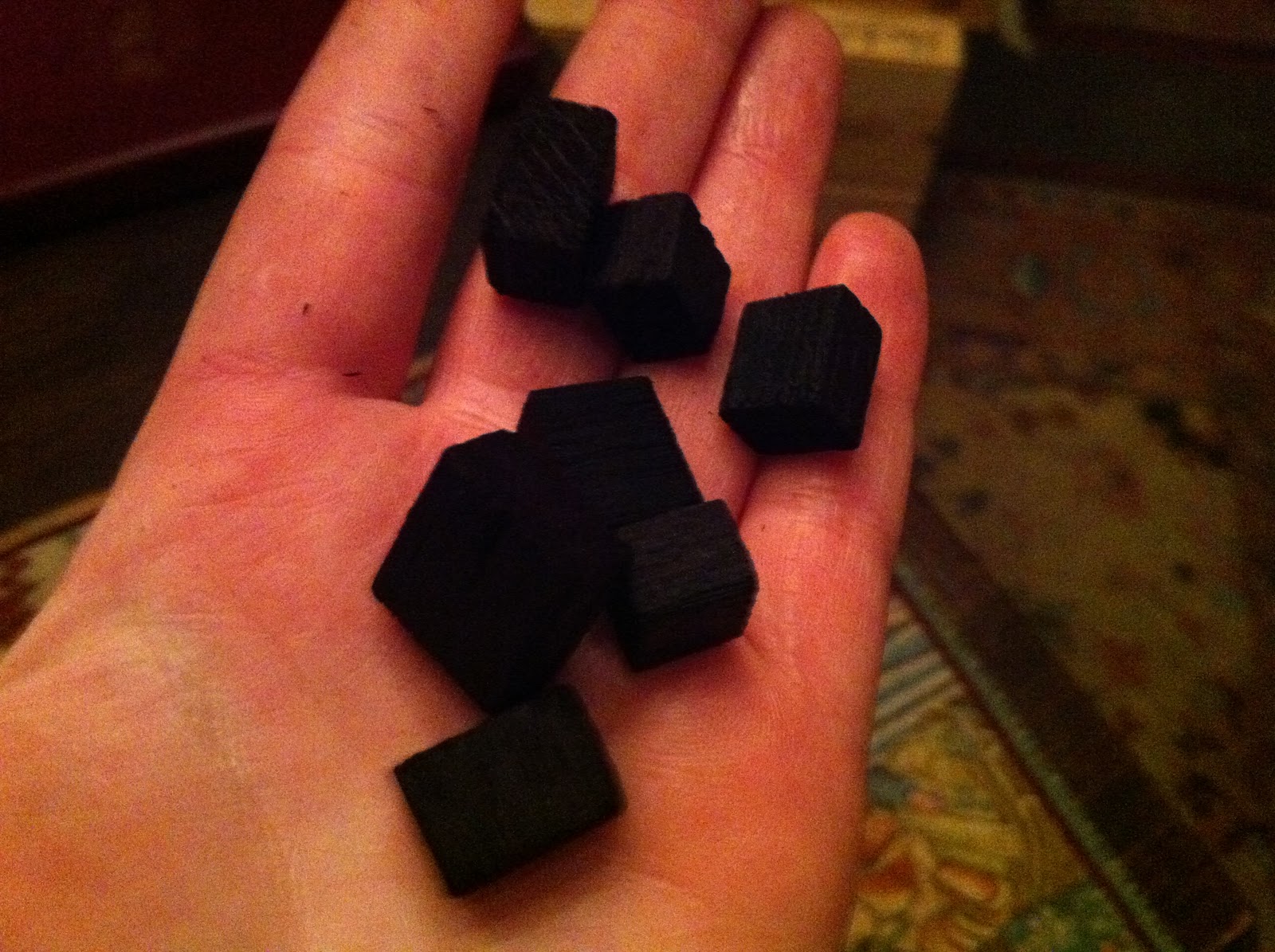
            It would be remiss of me not to interject a word about Wine Barrel Oak Staves. Okay so this was not my genius in its organic concept, i.e. it was not my idea to bring this “ingredient” into the kitchen. However, I was asked how to use staves to cook so I will gladly take credit for the application of and resulting products of the staves.
Oak Wine Barrels are used to house wine prior to bottling and selling. These barrels are what impart the oak to your wines, like Syrah. Staves are the actual lengths of wood that comprise such a barrel. Wineries that don’t like to purchase whole, new or used, oak barrels often choose the cheaper option of purchasing the wood chips of cut up used barrels to float on top of steel wine tanks, much like a tea bag floats and infuses water.
            Wineries will often just give these chips away after ‘x’ amount of uses - hence the appearance in the kitchen. I was up for the challenge while others scoffed and dismissed the idea. Like the old Jewish post-war and post-depression grandmothers I was used to, I knew I could get one or two more cups of “tea” out of this “tea bag”.

Then came the “sweet” idea of simple syrups - the obvious idea of smoking chips, and the not so obvious idea of infusing brines. (The same concept behind simple syrups and candies worked beautifully here - just take the simple syrup ratio from my earlier posts and drop in the chips while you’re still on the flame and taste until you’re satisfied with the flavor.)

Recipe for Success:

1 Corned Beef  (Out of the all powerful and benevolent Michael Ruhlman’s Charcuterie though I’m sure if you referenced the five volume Modernist Cuisine you would find that the authors would just inject brine and cryovaced it to have ‘same-day corned beef’.)

Spaetzel- 
½ c Rye Flour
½ c All-Purpose Flour
2 Whole Eggs
¼ c Milk
½ t Fine Sea Salt
2 T Toasted Fine Ground Caraway Seed
1 qt Fresh Grated Gruyere Cheese
1 pt Toasted Rye Crumbs
t.t. whole butter just enough to keep the Spaetzel from sticking

Greens –
2 bunches Mustard Greens
2 bunches Rainbow Swiss Chard
1 pint cooked bacon lardoons
                  t.t. salt nothing less then a tablespoon please
                  t.t. red wine vinegar literally a splash makes the difference

German Potato Salad –
20 ea Yukon Gold Potatoes
1½ c Dijon Mustard
                  1/3 C each Champagne Vinegar, Cider Vinegar, Balsamic Vinegar


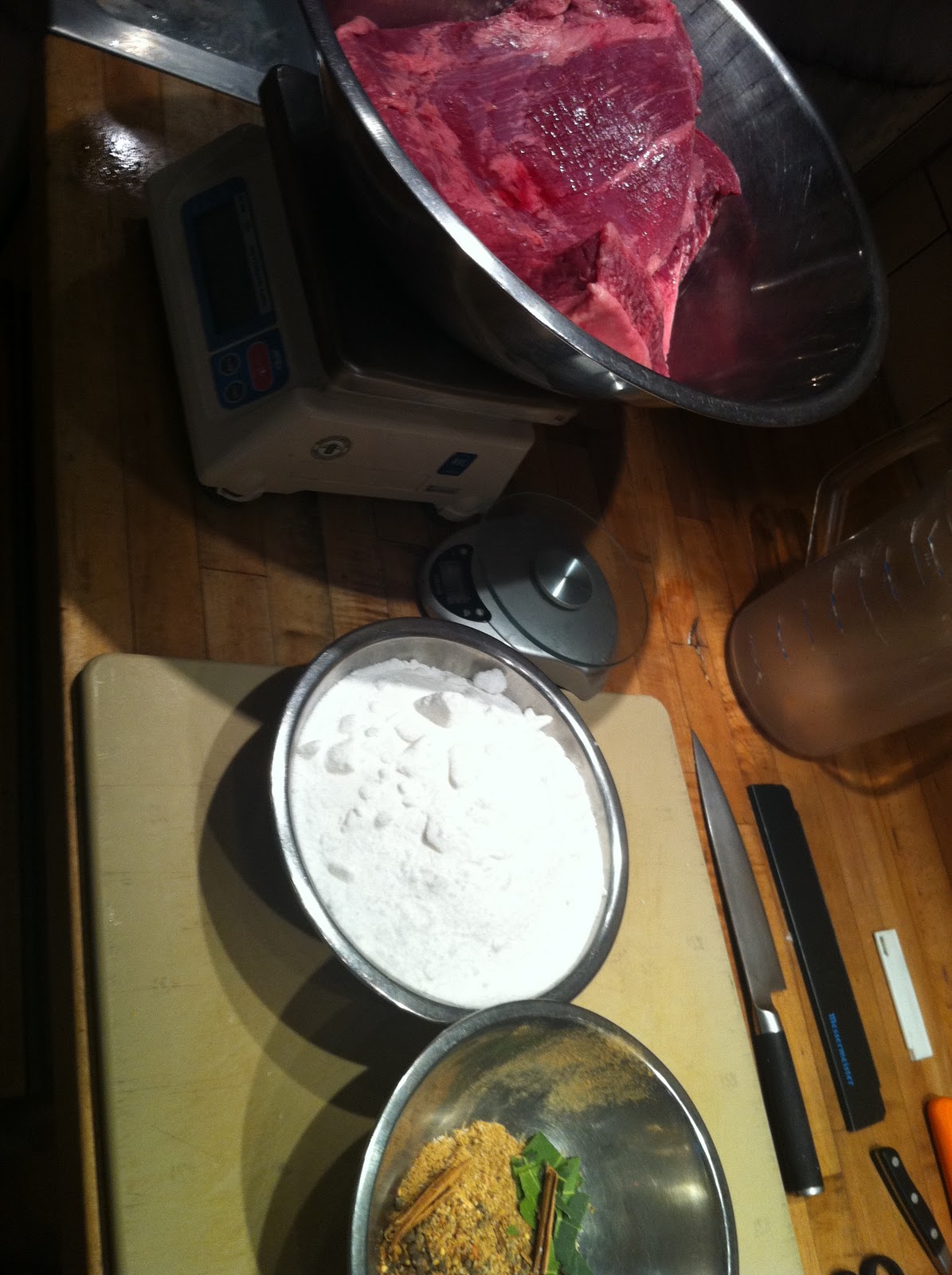
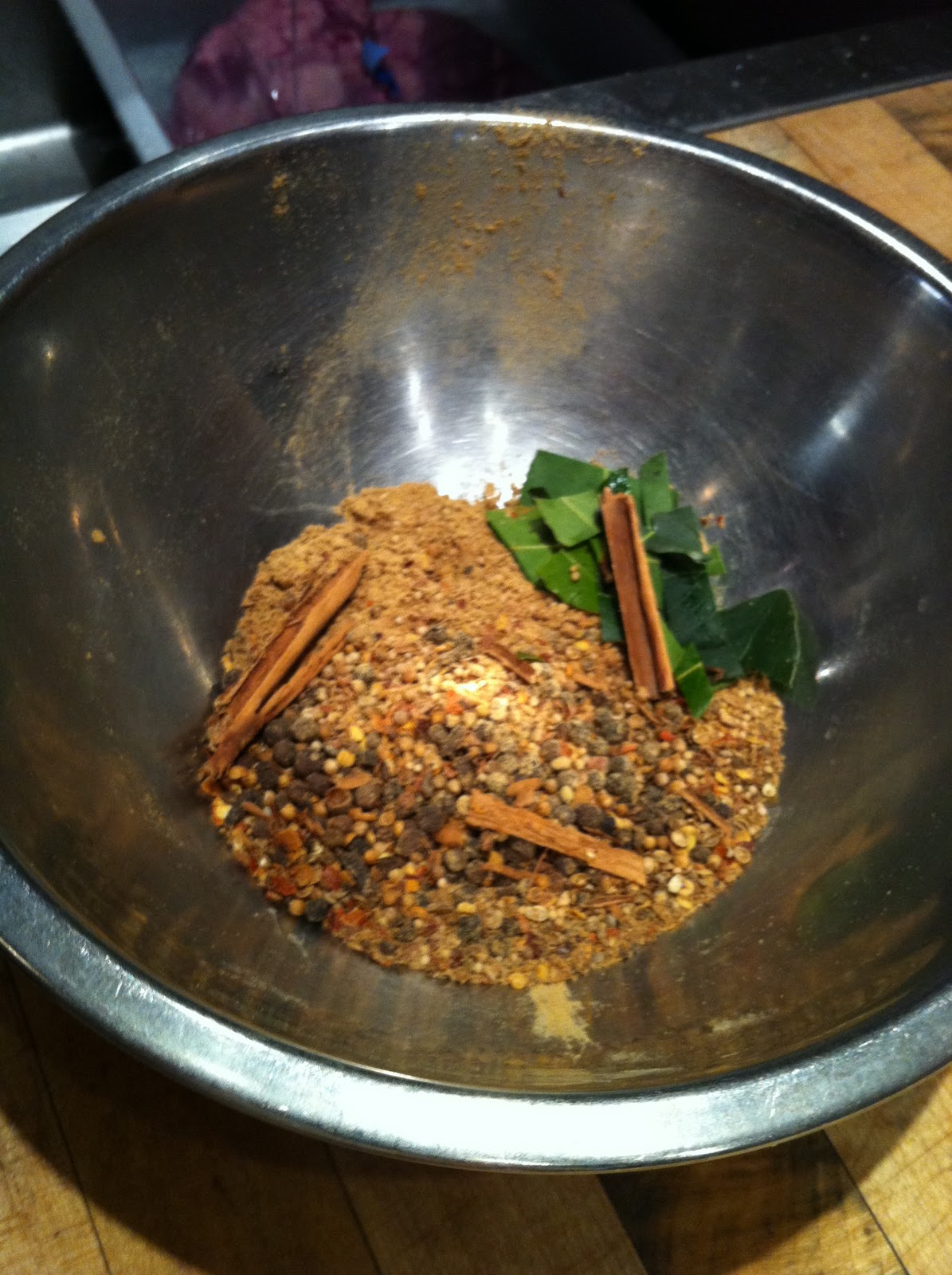
                        Brine the corned beef first and by first I mean seven – eight days before you want to eat. Insert picture fast forward montage here:


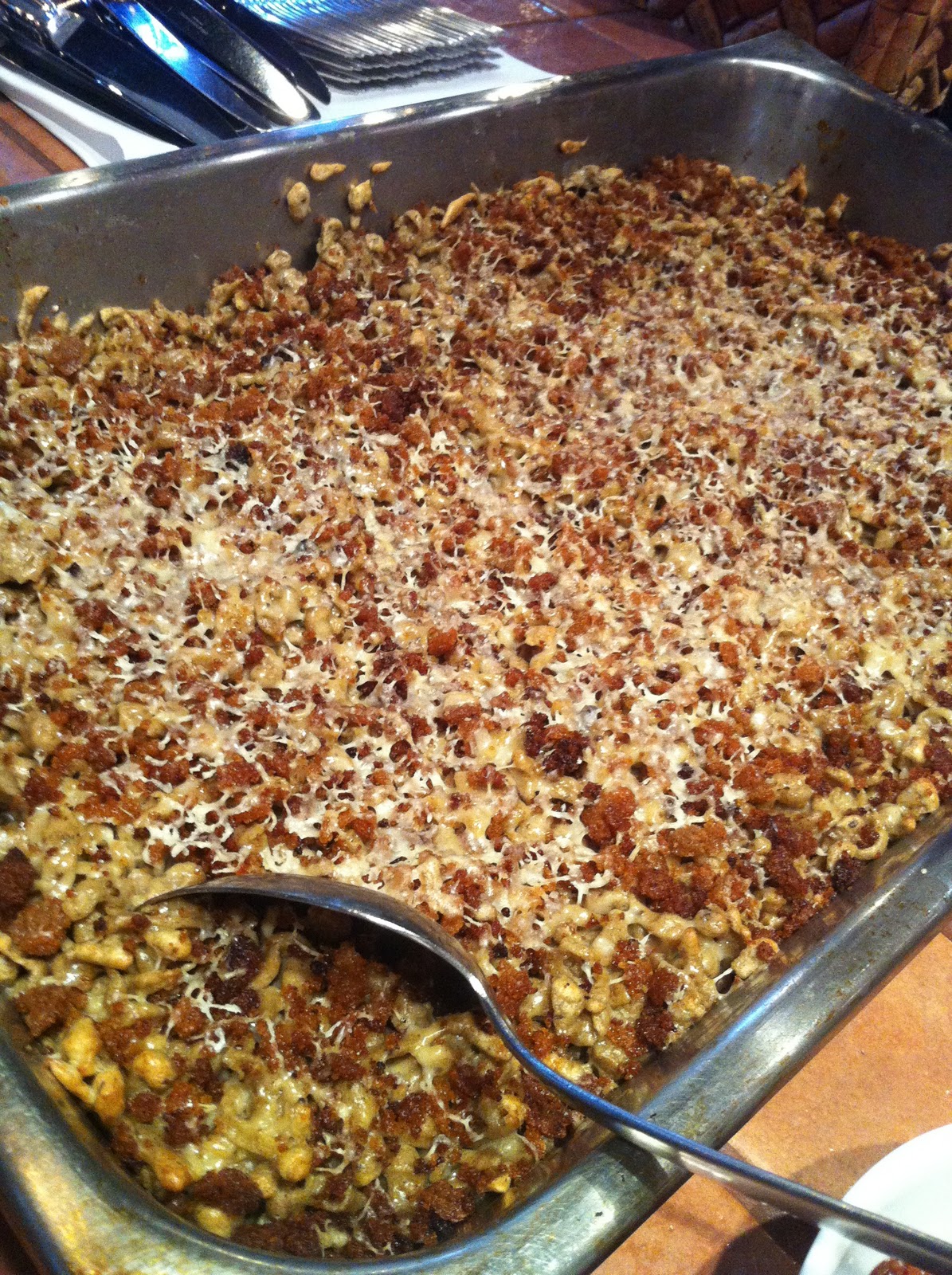
Make the Spaetzel batter by shifting the two flours and salt with an electric mixer. Combine the milk and lightly beaten eggs. Make an indent in the middle of the flour and pour the egg mixture into the crevice. Sprinkle in the toasted and finely ground caraway seeds. (Note: to toast caraway seeds, spread the whole seeds out in a single layer on a sheet pan and put them into a 350 degree oven until aromatic – wait until the seeds are cool to grind them.)

            Mix on medium speed with paddle until the gluten is developed.  It should take about 10-15 minutes. Then let the mixture rest to relax the gluten for at least 30 minutes.

            While it’s resting, peel and cut the potatoes. Place the potatoes into a pot and cover with cold water. Season the water with kosher salt, a bay leaf, a couple cloves of peeled garlic as well as a couple of tablespoons of olive oil. Place the pot over medium-high heat and bring to a simmer (never a full boil). Test the texture and flavor of the potatoes after about 15 minutes. If the potatoes are under seasoned, now is the time to season them by putting more salt into the cooking water. Potato salad texture is the goal: cooked with a ‘bite’- remember the potatoes will continue to cook after you strain them. Allow them to cool. 

           
            Take this time to clean and chop your greens, and if you haven’t already cooked the bacon lardoons, (small cubed bacon that, hopefully, you have leftover from the last challenge) do so now. 
                
            Next, cook the Spaetzel. This is fun and very involved, so I didn’t have a hand free to take a photo of how to do it but I’ve drawn a diagram for you. 


You want about 1 ½ inches of boiling water in a 4 inch hotel pan. Place a perforated hotel pan on top. Take the batter you’ve made and scrape it through the holes. The holes will naturally form little dumplings in the boiling water. Once the dumplings float to the surface of the water, they are ready to be scooped out with a slotted spoon or a spider. I toss mine immediately with a little whole butter to prevent sticking.
           
            Then place the Spaetzel into a casserole dish with the grated gruyere cheese and top with bread crumbs and more grated gruyere cheese. Place in 350 oven to bake until it’s golden brown about 10-15 minutes.

           
            Dissolve the mustard into about a cup of the three mixed vinegars and dress the potatoes as you would a salad. (Funny thing happened to me while I was mixing - I wanted a little more mustard but found I was out so I topped them potatoes with watercress, a spicy mustard green. Yummy!)

            While you are heating your corned beef with the au jus, get a pan on high heat with a touch of canola oil in it and throw in your washed greens. Sauté on high until tender. Throw in the cooked bacon lardoons and a splash of red wine vinegar with some salt and call it a day. Pull your golden casserole out of the oven, slice your beef, pull up your potato salad and there you have it: Corned Beef on Rye with Mustard.


                        I love brining food. It was as though a whole new world of moisture and flavoring proteins opened up to me when the first herb/salt water/sugar mix came into my life. I deviated a little from Ruhlman’s Charcuterie recipe, but the integrity of the recipe remains.
                       
Recipe for success:

The Brine- (for a 3-5lb Chicken brined 12 hours)
1 Gallon Water
1 c Salt
½ c Sugar
2 Bay Leaves
15 Cloves Garlic
                        1 ea Onion
                        2 T Pepper
                        1 bunch Tarragon
                        ¼ c Champagne Vinegar
                        150 grams Oak Wine Barrel Staves


                        The Coq au Vin -  
1 Brined Chicken
                        1 c cooked bacon Lardoons (reserve rendered fat)
                        1 qt cipollini onions
                        1 # mushrooms (quartered)                
½ c Madeira Cognac or Brandy
                        1 ½ c Red Wine (I used Pinot Noir, but Burgundy regionals are traditional)
                        1 Bay Leaf
                        2 Sprigs Thyme
¼ c Water
                        1T cornstarch
                       
                        Roasted Root Vegetables –
                        Equal parts:
                        Potatoes, carrots, and turnips
                        Note: If your carrot tops look as good as mine did wash and keep them for use for another time.)
2 large bunches of cooking greens i.e. mustard greens or chard
1 head Roasted Garlic and its reserved garlic oil
t.t. Salt and Cracked Pepper
t.t. Vinegar


Washed and Dried Miners Lettuce (or any green of your choice)
                                                 
            Start your chicken brining the day before. On the day of serving, blanch the onions in boiling water for 1 minute. This will make it easier to pull off the skin. Cook off your bacon using a rack and pan to catch the drippings so you can reserve the drippings. Break down your chicken into four types: wings, breasts, thighs, and legs. Heat the fat in a large rondo (shallow pot with raised sides). Brown the chicken breast over medium high heat until the skin is crispy. Place the breast on a rack over a pan and finish cooking in a 350 oven.
Using the same rondo and hot bacon fat, place the remaining chicken in the pot. Cook until dark brown. I added the chicken carcass to brown. Remove the browned chicken and rest on a rack over a pan. Remove the fond from the pan by pouring some red wine into the hot pan and scraping with a wooden spoon. Be careful to turn off the flames because the alcohol may catch on fire. (Note: if you do catch the wine on fire it’s no big deal the alcohol will just burn off. Plus you’ll look super cool to your friends when you’re calm and explain that to them.) When you’ve finished scraping all the good bits and pieces up with your wooden spoon, pour the hot liquid and fat into a melt-proof container, I use a metal one but don’t touch it without a buffer towel in your hand please.
            Next sauté your onions and mushrooms over high heat; this time keeping them in the pan while you pick up the fond with the Madeira. (Yet another flammable thing.) Reduce the wine down into a syrup. Return your bacon, reserved liquid and chicken thighs, wings, legs, and carcass to the pot. Cover ½ the way up the solids in the pot with: 1 part red wine and 1 part water.

            Cover the pot once the mixture returns to a simmer and place in 350 degree oven until the chicken is falling off the bone. If your cooking liquid is too watery you should think about dissolving a tablespoon of cornstarch in 1/4 C of water – straining off the braising liquid adding your cornstarch liquid and boiling to activate the starch. It will be nice and thick after that. While that is simmering, wash your vegetables. Cook them on separate sheet trays coated lightly in oil in a 500 degree oven. Since each vegetable has a different cooking time, you will need to remove each vegetable as it finishes. Toss the vegetables together with a couple tablespoons of your garlic oil and a few roasted garlic cloves and season up with salt and pepper. You can even throw in those reserved carrot tops while the vegetables are still warm so that the tops wilt. Sauté your greens toss those in too and serve.


            Yet again, I loved this challenge almost as much as I love the idea of Dominique and Kate in Seattle. All my cured heart is with them!